
 An independent think tank at the Riigikogu
 Report: Estonia could benefit from the European security crisis
The increasing NATO defence spending means there is an opportunity for Estonia to strongly develop its local defence industry. Its volume could grow to up to 6% of GDP in the next ten years. However, the growth of the local defence industry depends on Estonia’s ability to resolve its labour, regulatory and capital issues, according to the Foresight Centre’s new short report.
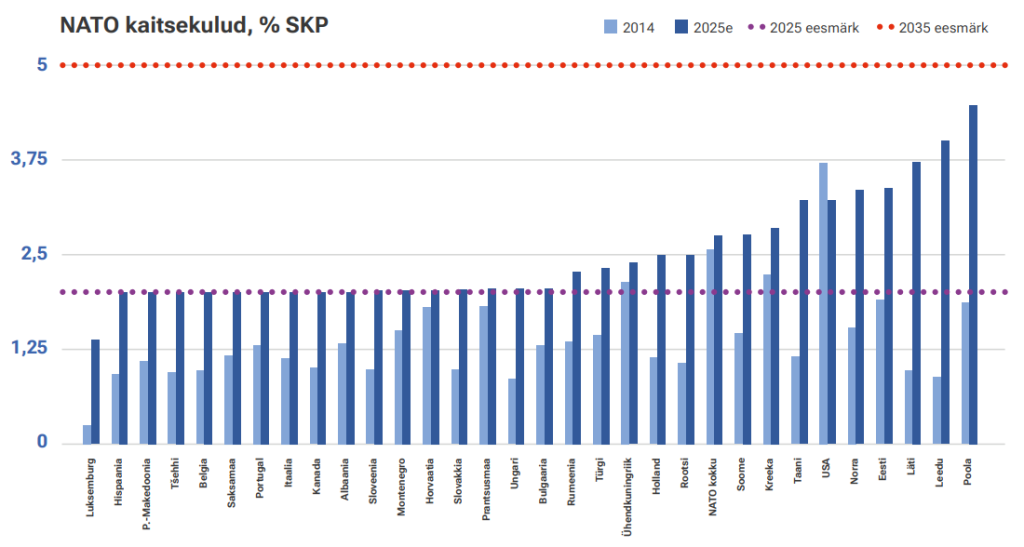
Olavi Miller, an expert at the Foresight Centre, explained that the increasing NATO defence spending means that demand for equipment in the European Union alone will increase up to 80 billion euros annually. Estonian companies could benefit from it. “Over the next decade, European countries will invest at least an extra trillion euros into acquiring defence equipment,” he said. “The European defence industry market is projected to grow potentially 49–80 billion euros per year. Estonian companies could capture some of it.”
NATO’s defence spending target of 5% of GDP by 2035 means NATO’s annual budget would double. Much of this would go towards equipment procurement. At the same time, the European Union’s strategic focus is on reducing its current dependence on the US. This, in turn, means that at least half of the necessary equipment is intended to be procured within the European Union.
“If Estonia can maintain its current 0.44% share in the equipment expenditure of European Union countries, as the market grows, the Estonian defence industry would get around 217 million euros extra in turnover every year,” said Miller.
If we assume more ambitiously that Estonia’s market share will grow to 1%, around 804 million euros in turnover and 269 million euros in added value would be added annually. “With well-targeted support measures, the Estonian defence industry sector could grow to 6% of GDP by 2035 thanks to export opportunities,” said Miller. “For example, in comparison, agriculture, forestry and fishing combined accounted for 2% of GDP last year. The added value of the entire construction sector was just over 6%.”
The Foresight Centre points out in its short report that as a small country, Estonia should focus on areas where we already have an advantage. These are primarily cyber defence, autonomous land and air systems, and dual-use technologies.
The strong development of the defence industry would be accompanied by a significant need for extra labour, up to 4800 people annually. At this growth rate, the number of employees employed in the defence industry would exceed the number of workers employed in the ICT sector within the next seven years. The Foresight Centre stresses in its short report that GDP growth will not occur if the extra labour is transferred to the defence industry from sectors that have higher added value.
Miller said that the Estonian state plays an important role in the growth of the defence industry sector. “The role of the state is, above all, to create an environment that accelerates innovation and product testing, while reducing regulatory barriers, enabling more flexible procurement models and supporting high-tech production and startups, for example by being the first ambitious customer itself,” Miller added. “Collaboration with Ukraine remains critical for testing and development.”
The short report “Prospects of the Estonian Defence Industry as Europe’s Defence Needs Grow” (in Estonian) has been prepared in the framework of the research stream “The Future of Economic Competitiveness”. The research stream analyses the future prospects, opportunities and obstacles of the Estonian economy and presents promising economic policy recommendations. The research stream is part of the work of the Competitiveness Expert Council established at the Economic Affairs Committee of the Riigikogu.
Latest news
-
01.10 2026Report: The competitiveness of the Estonian economy requires investments into technology and people’s skills
The Competitiveness Expert Council emphasises that, despite the recovery in foreign demand and the improved outlook for the Estonian economy, the long-term competitiveness of the Estonian economy depends on businesses’ investments into their employees’ skills, technology, automation and energy efficiency.