
 An independent think tank at the Riigikogu
Report: Psychological, economic and digital violence often remain outside the reach of support systems
The Foresight Centre points out in a report published today that intimate partner violence is changing faster than law enforcement and support services offered to victims are developing. There is currently no comprehensive support system to help victims of psychological, economic and digital violence.
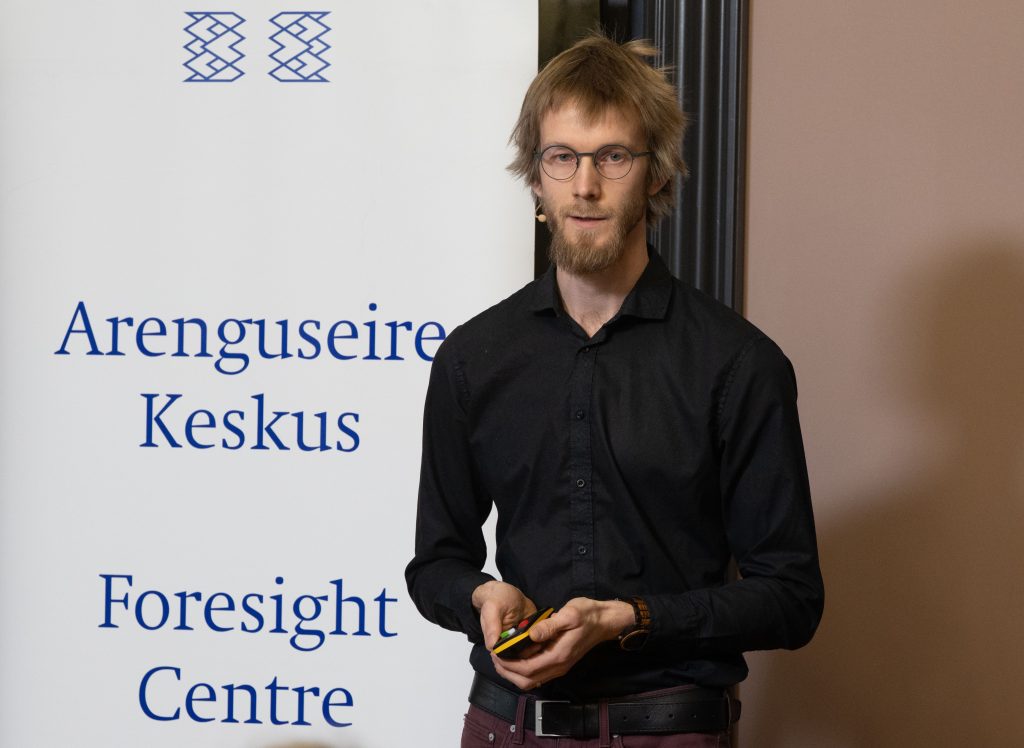
Kaupo Koppel, an expert at the Foresight Centre and head of the research stream on intimate partner violence, explained that intimate partner violence is most commonly recognised as physical and sexual violence, but the impact of other forms of violence on victims is no less significant. “For example, controlling behaviour, economic restriction, or psychological violence within the home are much more difficult to notice and prove, and as isolated acts, they may not meet the legal criteria for a crime,” said Koppel. “That’s why such cases usually don’t make it into official statistics, even though studies show that these forms of violence are widespread.”
Crime statistics only provide a partial picture of intimate partner violence. Physical abuse accounts for 82% of intimate partner violence crimes registered by the police. If we also take into account cases without offence, the most common form of violence is psychological violence, which occurs in 55% of all registered cases. Based on victim surveys, it is estimated that 80% of intimate partner violence remains unreported to the police.
The Foresight Centre points out in its report that the development of digital tools gives abusers more and more opportunities to monitor, control and harass their partners. Social media platforms and connected devices make it easier to collect information about a person, and artificial intelligence allows for the automation of harassment and the creation of deepfakes. Estonia must amend its legislation by June 2027 to address new forms of cyberviolence.
Noticing violence does not mean greater safety for victims if the recognition is not followed by assistance that improves the victim’s safety. When seeking help, what is decisive is not so much which institution the victim turns to, but how the specialist they come into contact with reacts. This may determine whether the victim continues to seek help or gives up.
“Help-seeking often stops when the victim feels that their experience is not believed, their sense of danger is not taken seriously, or they do not receive support in taking the next step,” said Koppel. “However, even professional, timely and consistent help may not ensure long-term safety if the victim is financially dependent on the abuser or if leaving the relationship carries a risk of escalation of violence.”
The report shows that the growing educational gap within Estonian couples is also becoming a significant source of uncertainty in terms of the future development of intimate partner violence. Between 2014 and 2026, the proportion of couples with different levels of education increased from 37% to 45%, mainly with the woman being more educated than her partner.
Women’s growing educational advantage can both reduce and, in certain situations, increase the risk of intimate partner violence. On the one hand, higher education and the economic independence that comes with it can improve a woman’s chances of leaving an abusive relationship. On the other hand, if rigid gender role expectations persist, her partner may perceive a weakening of his position and try to balance it with greater control and violence.
The aim of the Foresight Centre’s research stream “Prevalence and Trends in Intimate Partner Violence in Estonia” is to identify changing patterns of intimate partner violence and help-seeking trends in Estonia in order to assess its long-term impact and support the development of more effective interventions.
A presentation of the research results can be viewed here (in Estonian): https://arenguseire.ee/uritused/raporti-lahisuhtevagivalla-levik-ja-trendid-eestis-esitlus/
Latest news
-
05.11 2026Report: Domestic violence costs Estonia over a quarter of a billion euros a year
Domestic violence costs Estonian society an estimated €273 million a year, and this is actually a rather conservative estimate. According to “The Economic Cost of Intimate Partner Violence in Estonia”, recent short report by the Foresight Centre, the biggest costs are associated with loss of health and economic damage.