
 An independent think tank at the Riigikogu
 Report: The competitiveness of the Estonian economy requires investments into technology and people’s skills
The Competitiveness Expert Council emphasises that, despite the recovery in foreign demand and the improved outlook for the Estonian economy, the long-term competitiveness of the Estonian economy depends on businesses’ investments into their employees’ skills, technology, automation and energy efficiency.
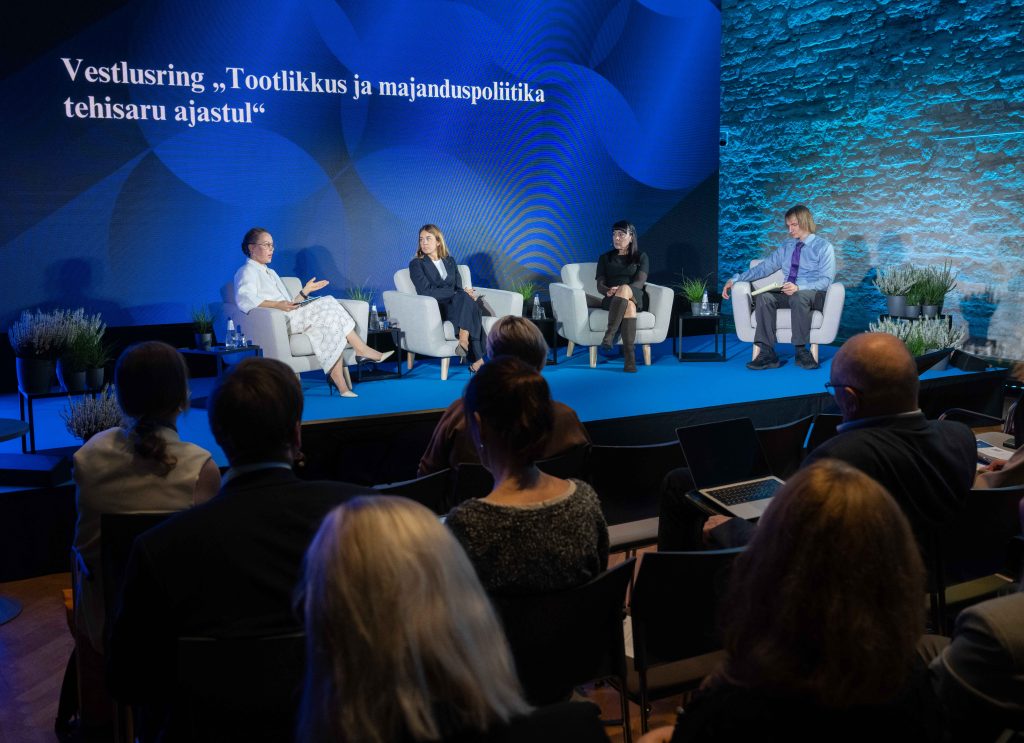
Uku Varblane, Head of Research at the Foresight Centre and a member of the Competitiveness Expert Council, said that the global economy remains volatile and that Estonia’s hopes for economic growth cannot be based solely on a recovery in external demand. “The next phase of growth for the Estonian economy must be based, above all, on our companies’ investments into research and development and its commercial application,” said Varblane.
According to the Competitiveness Expert Council, one of the greatest risks to the Estonian economy is that, due to the higher cost of capital and uncertainty, companies are postponing necessary investments in staff skills, process automation, new technologies and energy efficiency.
Investments into research and development by Estonian companies have grown at the fastest rate among the Baltic states, and while the gap with Finland has narrowed over the past ten years, it remains significant. Research and development expenditure by Estonian companies totalled 472 million euros in 2024, equalling the combined total for companies in Latvia and Lithuania. In 2024, research and development expenditure in the business sector accounted for 1.2 per cent of gross domestic product in Estonia, compared with 2.2 per cent in Finland.
In its report, the Expert Council stresses that Estonian companies need a more stable and predictable state, as uncertainty regarding future political decisions dampens their willingness to invest. Experts pointed out that long-term decisions on energy, budgetary and tax policies, in particular, require broader political consensus.
The report also indicates that global demand for services is growing, and this is increasing the share of services in Estonia’s foreign trade. IT and business services are playing an increasingly important role in Estonia’s service exports. The share of service exports has increased and now accounts for over forty per cent of total exports. “Estonian businesses have successfully expanded their exports to Central Europe – particularly to Germany, Poland and Lithuania,” said Mari Rell, an economist at Eesti Pank. “In the coming years, we will need to further diversify our export markets, and the European internal market offers valuable opportunities for finding new partners.”
At the same time, new regulations and restrictions on data flows are making the provision of cross-border digital services increasingly difficult. “Estonia must therefore play a more active role in shaping the European Union’s digital regulations and assess their impact on the competitiveness of our businesses at an earlier stage,” said Varblane.
The Expert Council also recommends giving public-sector financial instruments a clearer mandate, basing their management on actual risk, and reducing the fragmentation of the funding system so that funding instruments associated with different stages of development form a single logical pathway. The report stresses that public-sector financial instruments should not replace private capital, but rather attract more of it into projects. Therefore, when assessing their performance, one should consider not only the payouts but also the private capital engaged.
Growing European investment in defence and digital technology could open up new opportunities for the Estonian economy, provided that it can be linked to an increase in the productivity and export capacity of local businesses. “The primary aim of defence spending is to strengthen Estonia’s defence capabilities, but at the same time it’s worth considering how the growing demand for defence could provide a boost to Estonian businesses and exports,” said Varblane. “For example, the state can be the first client for Estonian companies, thereby providing the necessary references for foreign markets.”
The report by the Competitiveness Expert Council, ‘Status and Prospects of the Estonian Economy 2026’, (in Estonian) can be viewed here.
Latest news
-
21.09 2026Report: The future contribution of older people to the labour market depends on their skills, not on an increase in employment
Due to an ageing and shrinking population, the role of older people in the labour market is growing. However, Estonia cannot expect a significant increase in their employment rate, as it is already among the highest in Europe, as highlighted by the Foresight Centre in its new short report.