
 An independent think tank at the Riigikogu
 Report: Opportunities to attract private funding are better for sports than for culture
Over the last decade, the share of culture and sports in total government spending has decreased and more private funding is needed to ensure the vitality of these fields. According to the Foresight Centre’s new short report “State Funding Patterns for Culture and Sports”, this is easier to do for sports than for culture.
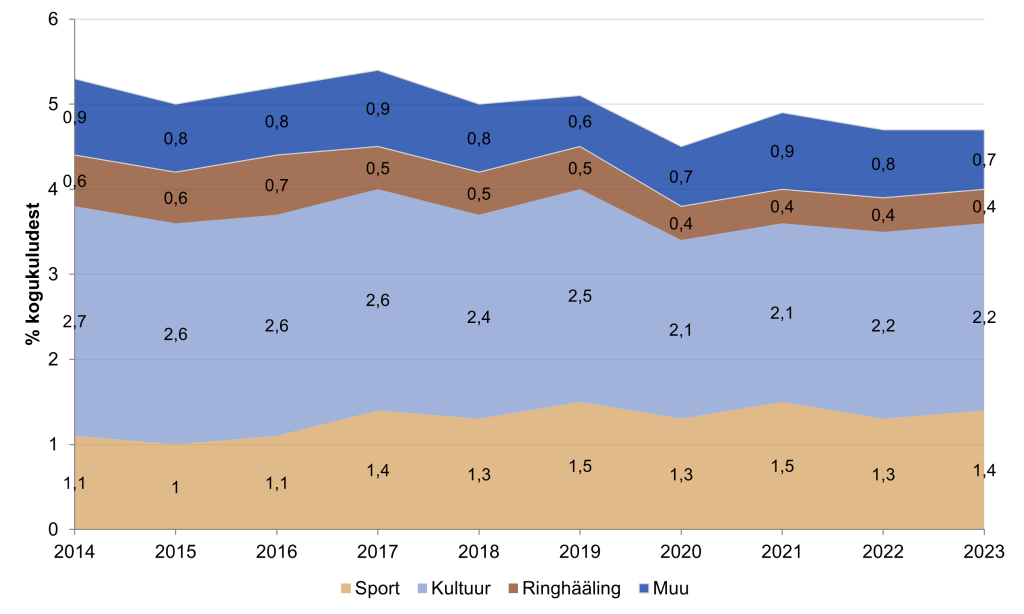
Uku Varblane, head of research at the Foresight Centre, explained that the total amount of funding for culture and sports has remained stable in Estonia over the years, but funding for cultural services has decreased somewhat while funding for sports has increased. “Estonian culture relies mainly on public sector institutions, while in sports, the majority of public funding goes to private sector organisations through support measures and bank transfers, which indicates that there are better opportunities for diversifying funding and attracting private money in sports,” said Varblane.
However, the share of leisure, culture, religion and sports in total government spending has decreased from 5.3% in 2014 to 4.7% in 2023. This shows that funding in this area has not kept pace with other sectors. However, the current share is still more than twice as high as the average in European Union countries.
In Estonia, funding for culture mainly relies on the activities of public institutions, which account for 70% of funding in culture. The share of bank transfers and support measures for private sector cultural organisations is presently only 7%, which is less than half the European average.
In sports, on the other hand, money is distributed more evenly and independent private sector organisations play a larger role in funding. The majority of funds in the sports sector come through bank transfers and support measures (31%), which means that independently operating organisations and clubs play a greater role.
Varblane added that as the cultural and sports sectors are based on different funding logics, the possibilities for diversifying their funding are different as well.
“The cultural sector faces a difficult question of how to increase the share of other sources of funding in a situation where public sector institutions play a central role in the funding model,” said Varblane. “In the sports sector, independently operating organisations already have a greater role. Its funding structure is more market-based compared to culture, which could support the involvement of private funding.”
The short report “State Funding Patterns for Culture and Sports” (in Estonian) has been prepared as part of the research stream “The Future of Private Funding in Culture and Sports”. The research stream examines the factors and trends influencing donations to the culture and sports sectors and their possible future developments.
Latest news
-
01.10 2026Report: The competitiveness of the Estonian economy requires investments into technology and people’s skills
The Competitiveness Expert Council emphasises that, despite the recovery in foreign demand and the improved outlook for the Estonian economy, the long-term competitiveness of the Estonian economy depends on businesses’ investments into their employees’ skills, technology, automation and energy efficiency.