
 An independent think tank at the Riigikogu
 Report: The mental health crisis is hindering young people’s independence and participation in society
The report, commissioned by the Foresight Centre, finds that in the future, an increasingly smaller generation of young people will shoulder greater responsibility in both economy and society. At the same time, the mental health crisis is hindering young people’s independence, decision-making abilities and participation in society.
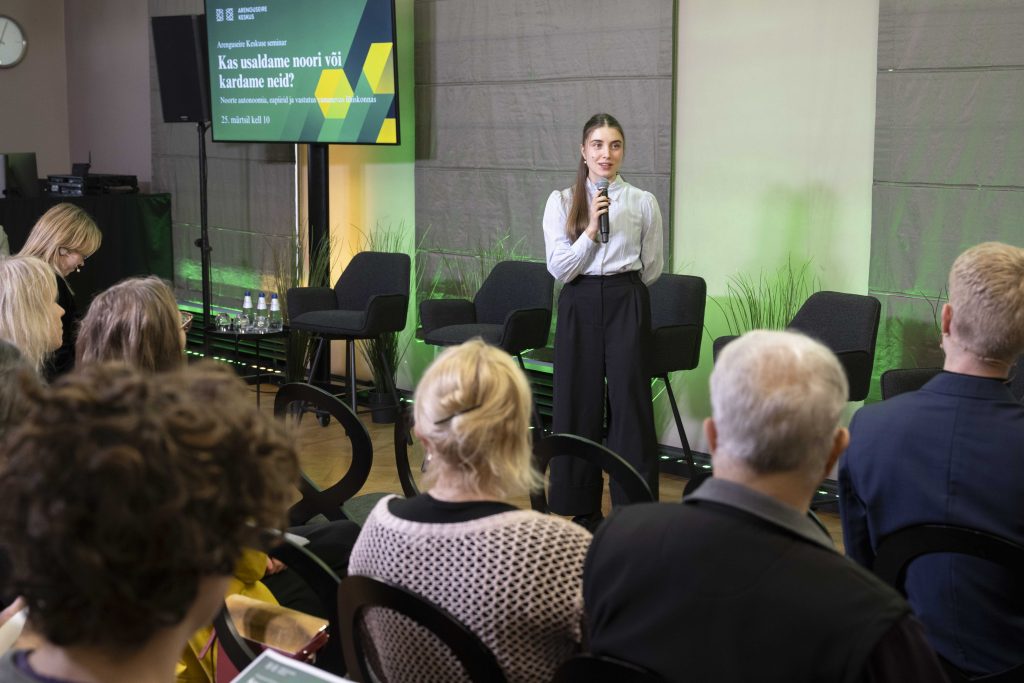
Eneli Kindsiko, an expert at the Foresight Centre, explained that youth is an increasingly long and uncertain stage of life today. “In the context of an ageing and shrinking population, we rely on younger generations more and more, but their actual independence is increasingly delayed, depending on their mental resilience, length of education, entry into the labour market and the cost of living,” said Kindsiko. “The starting point is also becoming more and more unequal for young people, depending very much on their family background.”
Studies show that generally, young people aged 16 and up have the cognitive skills necessary for making complex decisions. However, self-control mechanisms are still poorly developed at this age, and under time and social pressure, young people may fail to make the most well-considered decisions.
According to Tea Danilov, head of the Foresight Centre, in order for young people’s decision-making skills to develop, they need a safe space to make mistakes and practice decision-making and taking responsibility. “For example, young people could have more say in decisions at school and on school-related matters, whether it’s the start time of the school day or the menu in the school cafeteria,” says Danilov. “Studies confirm that lowering the voting age is reasonable and necessary, while making sure balanced information is available. It might also be possible for young people to engage in business in a simplified form from the age of 15 with their parents’ consent.”
Since taking responsibility also requires young people to have motivation and courage to act, the report stresses that young people’s voices must be heard both in politics and in wider society. The authors point out that today, Estonian youth have more rights, knowledge and opportunities for participation than before, but they have less and less faith that their choices or their input have a real impact.
The report highlights a concern that the deterioration of youth’s mental health is becoming a major hindrance in young people’s independence, decision-making abilities and participation in society. Estonian youth are significantly more frequently sad or depressed than youth in neighbouring countries. According to the Human Development Report 2023, over a third of girls and a fifth of boys aged 11-15 feel sad or depressed more than once a week. Meanwhile, access to mental health services in Estonia is uneven and waiting lists are long, and therefore young people don’t get help when they need it.
“If a young person lacks psychological coping skills and a sense of security, they may not be able to take advantage of existing educational, employment or participation opportunities,” said Kindsiko. “Thus, their life decisions will be postponed, they’ll have fewer options, and their dependence on family, school, or support systems will grow.”
The study finds that the digital environment and artificial intelligence are also increasingly determining how independent young people actually are. Therefore, young people’s ability to see through algorithmically directed information and use it in their own interests is becoming more and more important.
The digital environment has become a place where relationships, job opportunities, participation, self-expression and worldview are shaped. However, access to technology does not necessarily mean real autonomy, or acting consciously based on one’s own interests, because young people’s attention, information field, self-esteem and decisions can be strongly influenced by algorithmic systems.
Report “Youth Independence and Decision-making Authority in Estonia. Trends and Scenarios up to 2050” (in Estonian) has been commissioned by the Foresight Centre within the framework of the research stream “The Future of Youth Autonomy”. The aim of the research stream is to map the factors that influence youth autonomy (agency, decision-making power) and how well the developments in youth autonomy correspond to various age limits regulating young people’s rights.
Latest news
-
18.08 2026Report: A fifth of ride-hailing and courier service providers are at a dead end of their careers
The Foresight Centre notes in its new short report, “Does Platform Work Support Careers?” that a fifth of people providing ride-hailing or courier services via platforms are at a dead end of their careers, working full-time in a field for which they consider themselves overqualified.